
The room count of How to platformer is a date. Its 2,024 rooms end with a two-room finale that spells “Made in 2024”, and you have to clear every room to earn the 10 moons. This guide covers the level ID, what each block of rooms asks of you, which rooms end most runs, how long a clear takes and the platformer-mode skills you need to finish.
Key takeaways
- Rooms 1-600 teach one gamemode per block. From 601 the level adds mixed modes, invisible rooms, mini-size rooms and a second round of robot trials.
- Rooms 701-800 hide the layout until you get close, so slow, short movements beat speed there.
- Room 666 “EVIL” is the best-known run killer. One documented clear also died at 872, 1831 and 1997.
- Practice-mode drilling on single rooms saves more attempts than brute-forcing them in normal mode.
Fact-checked
We checked these key facts against the sources named, on November 20, 2026:
- Practice mode in platformer levels came to mobile in 2.205 (source: switchbladegaming.com)
- Rooms 601-1000 add twists: mixed modes, invisible layouts, mini-size icons and a return to the robot (source: geometry-dash-fan.fandom.com)
- The 1001-1100 set is called the “Speedrun Trials”, and it rewards moving quickly and cleanly instead of creeping (source: geometry-dash-fan.fandom.com)
- Its 2,024 rooms end with a two-room finale that spells “Made in 2024”, and you have to clear every room to earn the 10 moons (source: geometrydash.wiki.gg)
- The Steam 2.201 patch changed the default platformer sliding, and the 2.204 Steam patch in January 2024 lowered platformer air friction (source: gamepressure.com)
What How to platformer is and how to load it
How to platformer is a player-made Insane Demon platformer by thearmyants for update 2.2. Search for it by its ID, 104187415, so that you load the original and not a copy. The Official Geometry Dash Wiki calls it the most-liked and most-downloaded Insane Demon platformer level.
The level is one long tutorial. Each room is a short, self-contained challenge, and each block of rooms is harder than the one before. According to the Official GD Wiki, it teaches platformer mechanics in every platformer gamemode, but it leaves some things out: there are no dual sections, no pink dash orbs and no green orbs.
Loading the level on PC and mobile
The search steps are the same on Steam, iOS and Android. Inspired levels and reuploads use almost the same title, and only the original gives the 10 moons, so a search by name can easily open the wrong level.
Quick steps: load How to platformer
- Open Geometry Dash and press the right-hand button on the main menu (the online levels menu).
- Choose Search (the magnifying glass).
- Type 104187415 into the search bar.
- Run the search and open the level by thearmyants.
- Press Download, then Play.
After you download it, the level appears in your saved levels, and your progress stays with it while it is saved. Platformer levels use creator-placed checkpoints, so closing the game does not send you back to room 1 the way an old classic attempt would.
Insane or Extreme Demon? The rating explained
How to platformer is rated Insane Demon, and the Official GD Wiki and GDBrowser both list it that way. Many YouTube uploads call it an “Extreme Demon” or “Extreme Platformer” because one clear takes thousands of attempts and hours of play. That label is the uploader’s opinion. The in-game face and the moons you earn are Insane Demon.
Two kinds of difficulty are mixed here. Only a few single rooms come close to Extreme-level difficulty, and room 666 even shows an Extreme Demon face. Most of the challenge is stamina: you have to stay consistent across 2,024 rooms.
Room-by-room map: the 2,024 rooms block by block
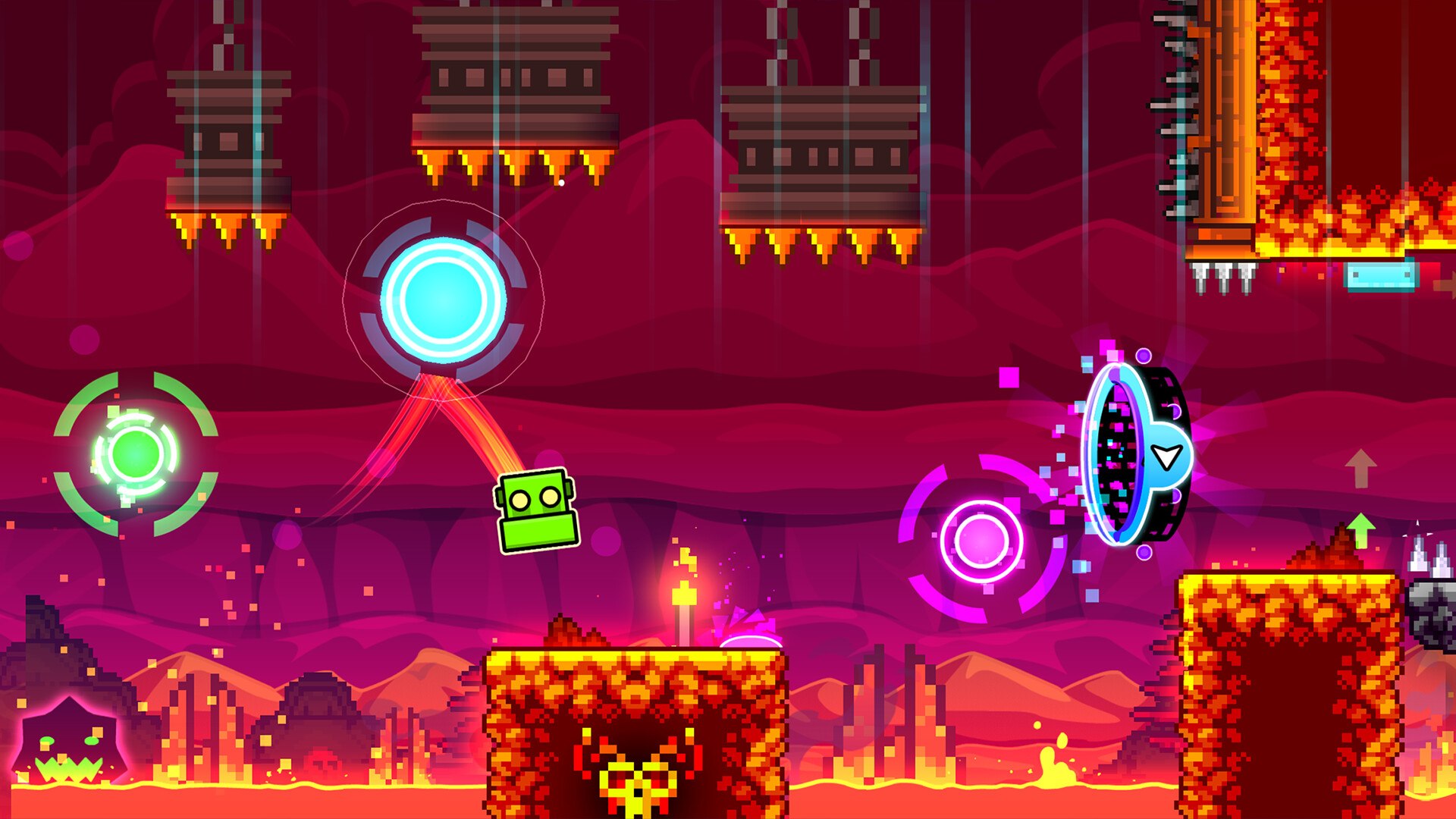
The rooms come in themed sets of 100, and the song changes at the start of each set. Rooms 1-600 introduce one gamemode per block. Rooms 601-1000 add twists: mixed modes, invisible layouts, mini-size icons and a return to the robot. After 1000 the level combines everything and keeps raising the difficulty until the finale.
| Rooms | Main gamemode(s) | What’s new | Difficulty notes |
|---|---|---|---|
| 1-100 | Cube only | Basic movement; spikes from room 27 | Warm-up, very forgiving |
| 101-200 | Cube, jetpack | Jetpack from room 102 | First real air control |
| 201-300 | Ball | Ball from room 202; pads from room 205 | Gravity switching on cue |
| 301-400 | UFO | Purple orbs from room 325 | Tap-timing rooms |
| 401-500 | Spider | Spider teleport gravity | Reading floor and ceiling |
| 501-600 | Robot | Robot variable jump | Hold-length control |
| 601-700 | Mixed: UFO from 613, jetpack around 690, cube at 694 | Room 666 “EVIL”; room 668 shows your attempt count on screen, then room 669 returns you to UFO | First major wall |
| 701-800 | Invisible rooms in each mode, starting as cube | Objects appear only when you are close, and the background is hidden; visibility returns in room 800 | Memory and caution |
| 801-900 | Mini Trials: mini robot, then jetpack and UFO | Mini-size icon on small blocks for the first 50 rooms; cube from room 882 | Includes room 872 |
| 901-1000 | Robot Trials Part 2 | Room 901 “Robot trials…” and room 902 “PART 2!!!!” pick up from 501-600 | Harder robot hold control |
| 1001-1100 | Mixed | “Speedrun Trials”; room 1001 teases you for thinking the level ended at 1,000 | Pace and consistency |
| 1101-1500 | Mixed | Harder combinations | Long grind stretch |
| 1501-1600 | Mixed | Flipped rooms | You have to read layouts in reverse |
| 1601-2000 | Mixed | Late-game rooms with very tight spacing around hazards | Includes walls at 1831 and 1997 |
| 2001-2024 | Ending rooms | Room 2023 “Made In…” with thearmyants’ logo | Rooms 2023 and 2024 spell “Made in 2024” |
Rooms 1-600: one gamemode per block
The first 600 rooms are the tutorial the title promises. Each block brings in one mode, opens with simple layouts and ends with layouts that need real control. The ball block adds pads early, at room 205. The UFO block adds purple orbs at room 325. By room 600 you have used every mode in the level: cube, jetpack, ball, UFO, spider and robot.
Rooms 601-700: mixing modes and room 666
This is the block where the level stops holding your hand. You switch back to UFO at room 613 and then move between modes inside the same block. The block also contains room 666 “EVIL”, the jetpack room most runs stall on. Two rooms later, room 668 shows your attempt count on screen, a deliberate jab after the wall you just cleared. Room 669 puts you back in the UFO, a brief jetpack stretch comes around room 690, and room 694 returns you to the cube to close the block.
Rooms 701-800: invisible rooms
In rooms 701-800 you play each gamemode again, starting with the cube, but the layout is invisible. According to the Official GD Wiki, objects only appear when your icon is close to them, and the background is hidden too. The modes rotate through ball, jetpack, robot and spider, robot comes back near the end, and room 800 clears the effect.
How to approach invisible rooms:
- Move in short steps. Hazards only appear inside a small radius, so speed means you will run into spikes before they show up.
- Treat each room as a memory test. Rooms are short, so after one or two deaths you know the layout, and the invisibility stops mattering much.
- In jetpack and UFO rooms, hover or tap gently to show what is ahead before you commit to a direction.
- Put a practice checkpoint at the entrance of any room that takes more than a few attempts, learn it, then clear it in normal mode.
Rooms 801-900: Mini Trials and mini hitboxes
The Mini Trials shrink your icon. You start as a mini robot on mini blocks for 50 rooms, then move to jetpack and UFO, and return to the cube from room 882. Room 872, a major wall in the documented 100% run, falls inside this mini flying stretch.
At mini size your icon is smaller and its jumps are shorter. The layouts are built to match, so the gaps and platforms are much tighter than in earlier blocks. The habit that helps most is making smaller inputs: short robot holds, light jetpack taps and single UFO clicks. Inputs sized for full-size icons will overshoot the mini platforms.
Rooms 901-1500: robot part 2, Speedrun Trials and harder combinations
Rooms 901-1000 bring back the robot as “Robot Trials Part 2”, with harder hold-length control than the 501-600 block. After room 1000 you stop learning new rules and start combining the old ones. Rooms switch modes inside a single room, and there are fewer easy rooms between the hard ones.
Room 1001 makes fun of you for thinking the level ended at 1,000 rooms. The 1001-1100 set is called the “Speedrun Trials”, and it rewards moving quickly and cleanly instead of creeping. That block also answers “is there a speedrun for how to platformer”: the level has its own built-in speed section.
Rooms 1501-2024: flipped rooms and the finale
The 1501-1600 set flips its rooms, so habits you have built over 1,500 rooms start working against you. Slow down for the first few rooms of that block. The 1601-2000 stretch holds the hardest late rooms. Their margins are so tight that you need to know exactly how close you can get to a hazard. The ending rooms then close the level with the “Made in 2024” message.
Did you know?
The room count is a nod to the release year. According to the Official Geometry Dash Wiki, room 2023 is titled “Made In…” and shows thearmyants’ logo, and together rooms 2023 and 2024 spell out “Made in 2024”.
The soundtrack: 10 Kevin MacLeod tracks
The level uses 10 songs by Kevin MacLeod and one sound effect, and the song changes every 100 rooms. The Official GD Wiki confirms where four of the tracks play. The other six rotate through the remaining blocks.
| Track | Where it plays |
|---|---|
| Amazing Plan | Cube Trials, rooms 1-100 |
| BossaBossa | Jetpack Trials, rooms 101-200 |
| Fluffing a Duck | Ball Trials, rooms 201-300 |
| March of the Spoons | Robot Trials Part 2, rooms 901-1000 |
| Breaktime | Later blocks |
| Cyborg Ninja | Later blocks |
| Desert City | Later blocks |
| Local Forecast | Later blocks |
| Meatball Parade (High Quality version) | Later blocks |
| Monkeys Spinning Monkeys | Later blocks |
Break at the music change
Split the run into 100-room blocks. The song changes every 100 rooms, so the music change is a natural place to stop before fatigue leads to careless deaths.
The rooms that end runs
A handful of rooms cause a large share of deaths. In one documented 100% run posted on YouTube, the player’s major deaths came at rooms 666, 872, 1831 and 1997. Use them as morale checkpoints: once you are past one, the next stretch usually feels easier.
| Room | Section | What is known | Approach |
|---|---|---|---|
| 666 “EVIL” | 601-700 | Hard jetpack room with an Extreme Demon face in the centre | Drill it in practice mode first |
| 872 | 801-900 Mini Trials | Mini-size room; major wall in a documented 100% run | Use small inputs, practise from the entrance |
| 1831 | 1601-2000 | Late-game wall with tight hazard spacing | Learn the exact safe distance to each hazard |
| 1997 | 1601-2000 | Final major wall before the ending rooms | Practise until it is consistent; fatigue is the risk |
Room 666 “EVIL” (jetpack)
Room 666 is a jetpack room titled “EVIL”, with an Extreme Demon face in the middle. The Official GD Wiki singles it out as particularly difficult. It tests sustained jetpack control: you have to manage height and drift together for the whole room, not for a single jump.
Two habits help here. Keep your thrust inputs short and frequent instead of holding for long stretches. Use the lower air friction from the 2.204 patch to correct sideways drift late. Put a practice checkpoint at the entrance and clear the room several times in a row before you try it in normal mode.
Late-game walls: 1831 and 1997
The late walls are a different problem from 666. You pass them by skimming hazards closer than they look, which is hard to work out by trial and error.
The fastest way through is to watch a clean clear of the room first. It shows you the intended path and how close you are allowed to get. Then rebuild the inputs in practice mode. Fatigue matters too. Room 1997 comes after nearly 2,000 rooms, so play it at the start of a session, not at the end of one.
Stay safe
Ignore downloads or links promising instant completions, free moons or “skips” for this level. Third-party tools carry malware risk and can get your account removed from leaderboards. The 10 moons only count from a real clear.
Platformer mode basics you need first
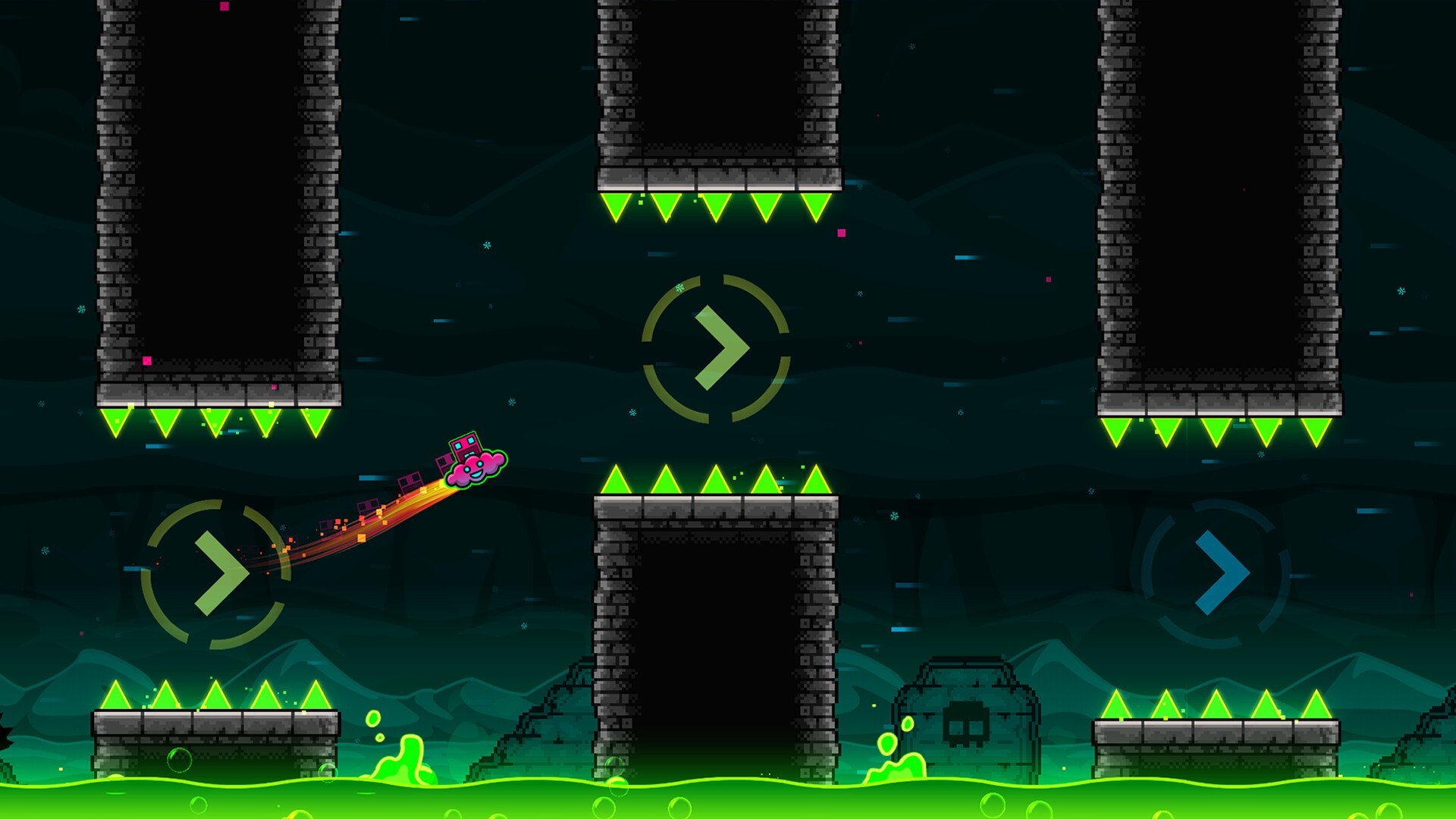
Platformer mode arrived in update 2.2, which RobTop Games (the studio of Geometry Dash creator Robert Topala) released on 19 December 2023 for iOS, Android and Steam. You control left and right movement, the camera does not scroll on its own, and you finish by reaching the end instead of surviving a song.
| Feature | Classic mode | Platformer mode |
|---|---|---|
| Movement | Auto-scrolls forward | You move left and right |
| Reward currency | Stars | Moons |
| Length tag | Tiny to XL | No length tag (similar minimum durations apply under RobTop’s rating guidelines) |
| Flying mode | Ship | Jetpack replaces the ship |
| Wave and swing | Available | Not available |
| Progress model | Percent through a song | Reach the end, with creator checkpoints |
| Checkpoints in normal mode | None | Creator-placed checkpoints persist |
Platformer mode keeps the cube, ball, UFO, spider and robot, and the jetpack takes the ship’s place. Wave and swing do not exist in platformer mode, so How to platformer cannot teach them.
Controls on keyboard, touch and controller
On PC you move with A and D or the arrow keys, and you jump with W, Up Arrow, Space or a click. On mobile, platformer levels show left and right buttons on one side of the screen and a jump area on the other. On a controller you move with the stick or D-pad and jump with a face button.
The physics changed slightly in the early 2.2 patches. The Steam 2.201 patch changed the default platformer sliding, and the 2.204 Steam patch in January 2024 lowered platformer air friction. In practice you have a bit more control over your drift in the air, so you can steer a jump late instead of committing at takeoff.
Platformer mode also gives you a short grace window, usually called coyote time: you can still jump for a split second after walking off a ledge. On tight edges, the common mistake is jumping too early and clipping the spike in front, not jumping too late.
Analyst note
Use coyote time on narrow ledges: walk to the very edge and jump just as you leave it. The grace window lets you use the full length of the platform without hopping early.
Practice mode and checkpoints in platformer levels
Platformer levels have two kinds of checkpoints. Creator-placed checkpoints work in normal mode: touch one to activate it, and if you crash you respawn at the last one you activated. Practice mode lets you add your own checkpoints on top of these, so you can repeat a single jump.
At the 2.2 launch, practice mode could not normally be used in platformer levels. Community guides date the fix to 2.201 on Steam and 2.205 on mobile. To use it, pause and press the practice button. On PC, the default keys are Z to place a checkpoint and X to remove one. A practice run never counts as a completion.
In How to platformer, practice mode is most useful on single rooms. Drill room 666, an invisible room you keep dying in or a late wall until you clear it most of the time, then go back to normal mode.
Did you know?
When platformer mode launched in update 2.2, platformer levels had no regular practice mode. According to community guides tracking the patches, it arrived later in 2.201 on Steam and 2.205 on mobile.
The 4 official platformer levels to warm up on
Geometry Dash has 26 developer-made levels. Wikipedia counts 22 auto-scrolling levels and 4 platformer levels: The Tower, The Sewers, The Cellar and The Secret Hollow. They are much shorter than How to platformer and are a quick way to get used to jetpack drift and movement before a 2,024-room run. If “how many levels” means how many platformer levels the game ships with, the answer is these four.
How long does How to platformer take?
Expect many hours spread over several sessions. One documented 100% run took about 8,000 attempts and about 13 hours in total. The same run log estimates 3-5 hours, which is closer to what a strong platformer player who already knows the level might need.
The gap between those figures comes mostly from the hard rooms. Rooms 1-600 go quickly. Deaths pile up at 666, in the invisible and mini blocks between 701 and 900, and at the late walls. Your attempt count depends far more on how quickly you learn those rooms than on how fast you move through the easy ones.
A practical way to plan the grind:
- Play rooms 1-600 in one or two sessions to learn the controls and every gamemode.
- Give room 666 its own practice session before you play through the 601-700 block.
- Take 701-800 slowly and treat each invisible room as a short memory test.
- Before 801, adjust to smaller inputs for the mini-size icon.
- Play 901-1500 in sessions of one or two 100-room blocks.
- Before 1501, spend a few minutes getting used to the flipped layouts.
- Before the late stretch, watch clean clears of 1831 and 1997, then practise them on their own.
- Finish rooms 2023-2024 and check that the level shows as complete with 10 moons credited.
Tips to beat it faster
Most of the time you save comes from practice habits, not raw skill.
What you need before starting:
- Geometry Dash on version 2.2 or later (Steam, iOS or Android)
- The level downloaded by ID 104187415
- Practice mode, which needs patch 2.201 or later on Steam or 2.205 or later on mobile
- A steady input setup, such as a keyboard with A/D or a controller, for the precise jetpack rooms
Habits that save attempts:
- Practise a room first, then run it. Practice mode on hard rooms takes fewer total attempts than brute-forcing them in normal mode.
- Trust coyote time. On narrow ledges, jump at the last moment, not early.
- Tap the jetpack instead of holding it. Short bursts are easier to control than long holds.
- Read each room before you move. The camera does not scroll in platformer mode, so standing still for two seconds costs you nothing.
- Shrink your inputs in the Mini Trials and slow down at the start of the flipped block at 1501.
Common mistakes and fixes:
| Mistake | What happens | Fix |
|---|---|---|
| Searching by name | You load a copy that gives no moons | Search 104187415 |
| Brute-forcing room 666 in normal mode | Hundreds of wasted attempts | Practise it in practice mode first |
| Rushing invisible rooms | You hit hazards before they appear | Move in short steps until the layout shows |
| Full-size inputs in Mini Trials | You overshoot small platforms | Use short holds and light taps |
| Jumping early off ledges | You fall short of tight gaps | Use coyote time and jump at the edge |
| Playing late walls while tired | Inconsistent runs at 1831 and 1997 | Start a fresh session at these rooms |
Expected result: when you clear room 2024, the level is marked complete and you get 10 moons. If you join a Geometry Dash community Discord, you can compare room clips with other players, which helps most on the late walls.
Levels to play after How to platformer
What to play next depends on what you liked. FURY OF 500 was directly inspired by How to platformer, according to the Official GD Wiki, so it suits players who want more room-based grinding. For shorter, more varied platforming, the official 2.2 levels (The Tower, The Sewers, The Cellar and The Secret Hollow) show RobTop Games’ own take on the mode.
The honest counter-argument: another 2,000-room level gives you more of the same, not new skills. Once you have beaten this one, harder short platformer demons will improve your movement faster than another long grind. If you are newer to the game overall, a Geometry Dash guide to the early levels will firm up your classic-mode basics before you take on more demons.
FAQ
How do you do platformer mode in Geometry Dash?
Open any platformer level. Platformer mode is set by the level, not by a menu toggle. You move left and right yourself, the camera does not auto-scroll, and you finish by reaching the end. The mode arrived in update 2.2 in December 2023.
What is the ID for How to platformer in Geometry Dash?
The ID is 104187415. Enter it in the Search tab of the online levels menu to load the original level by thearmyants.
How many levels or rooms are in How to platformer?
It is one level with 2,024 rooms, and you must clear all of them. If you mean official platformer levels, the game has 4: The Tower, The Sewers, The Cellar and The Secret Hollow.
Is Geometry Dash a platformer?
Geometry Dash began as an auto-scrolling rhythm platformer. Since update 2.2, it also has a dedicated platformer mode with free left and right movement.
How do you play platformer levels in Geometry Dash on PC?
Move with A and D or the arrow keys. Jump with W, Up Arrow, Space or a click. In practice mode, Z places a checkpoint and X removes one.
How do you get platformer mode in Geometry Dash on mobile?
Update to version 2.2 or later and open a platformer level. On-screen left and right buttons appear automatically. Practice mode in platformer levels came to mobile in 2.205.
What is room 666 in How to platformer?
Room 666 is a hard jetpack room titled “EVIL” with an Extreme Demon face in the centre. It is the best-known wall in the level, and room 668 shows your attempt count right after it.
What happens in rooms 701-800 and 801-900?
Rooms 701-800 are invisible: objects only appear when you are close, and the effect clears in room 800. Rooms 801-900 are the Mini Trials, which start with a mini robot for 50 rooms, move to jetpack and UFO, and switch to the cube from room 882.
What songs are in How to platformer?
There are 10 Kevin MacLeod tracks, and the song changes every 100 rooms. Amazing Plan plays in rooms 1-100, BossaBossa in 101-200, Fluffing a Duck in 201-300 and March of the Spoons in 901-1000.
Is How to platformer an Insane or Extreme Demon?
It is rated Insane Demon in the game. “Extreme” in YouTube titles is the uploader’s view of how hard it feels, not the official rating.
How long does it take to beat How to platformer?
One documented 100% run took about 8,000 attempts and about 13 hours. The same run log estimated 3-5 hours for a player who already knows the level.
How many moons do you get for How to platformer?
You get 10 moons for completing it.
About this article

Written by Joseph Smith
Joseph Smith is a digital nomad born in the 90s who grew up on PlayStation platformers and Halo 2 multiplayer. He plays Counter-Strike and Dota 2 competitively and started Toopics to bring gamers closer together, especially through Discord. More about Joseph
- Published
Sources (8)
- How to platformer - Official Geometry Dash Wiki (geometrydash.wiki.gg)
- How to platformer - Geometry Dash Fan Wiki (geometry-dash-fan.fandom.com)
- How to platformer by thearmyants - GDBrowser (gdbrowser.com)
- How to platformer 100% run (YouTube) (youtube.com)
- RobTop - Wikiwand (wikiwand.com)
- Geometry Dash - Wikipedia (en.wikipedia.org)
- RobTop Games rating guidelines (robtopgames.com)
- Geometry Dash: How to Practice Mode on a Platformer Level (2.2) (gameplay.tips)