
VCT, short for Valorant Champions Tour, is Riot Games’ official pro circuit for Valorant. Four international leagues (Americas, EMEA, Pacific and China) feed into two Masters events and one season-ending Champions tournament. Below we cover how a season runs, how teams qualify, and how to keep up with the VCT schedule without missing matches.
What VCT is, in one paragraph
VCT is a franchised league system with an open path underneath it. Partnered teams hold long-term spots in one of four regional leagues. Teams outside that group compete in Challengers circuits, and the best of them can earn promotion. Every result in the regional leagues feeds into the international events: Masters twice a year, then Champions, which crowns the world champion.
People search “vcts” and “VCT Valorant” for the same thing. VCT is the whole tour. Champions is the final event within it. When someone says “they made Champs,” they mean that one tournament, not the season.
The four international leagues
Riot moved to this structure in 2023. Each league plays in a home studio, which gives each region a consistent broadcast slot and a live audience.
| League | Regions covered | Home base |
|---|---|---|
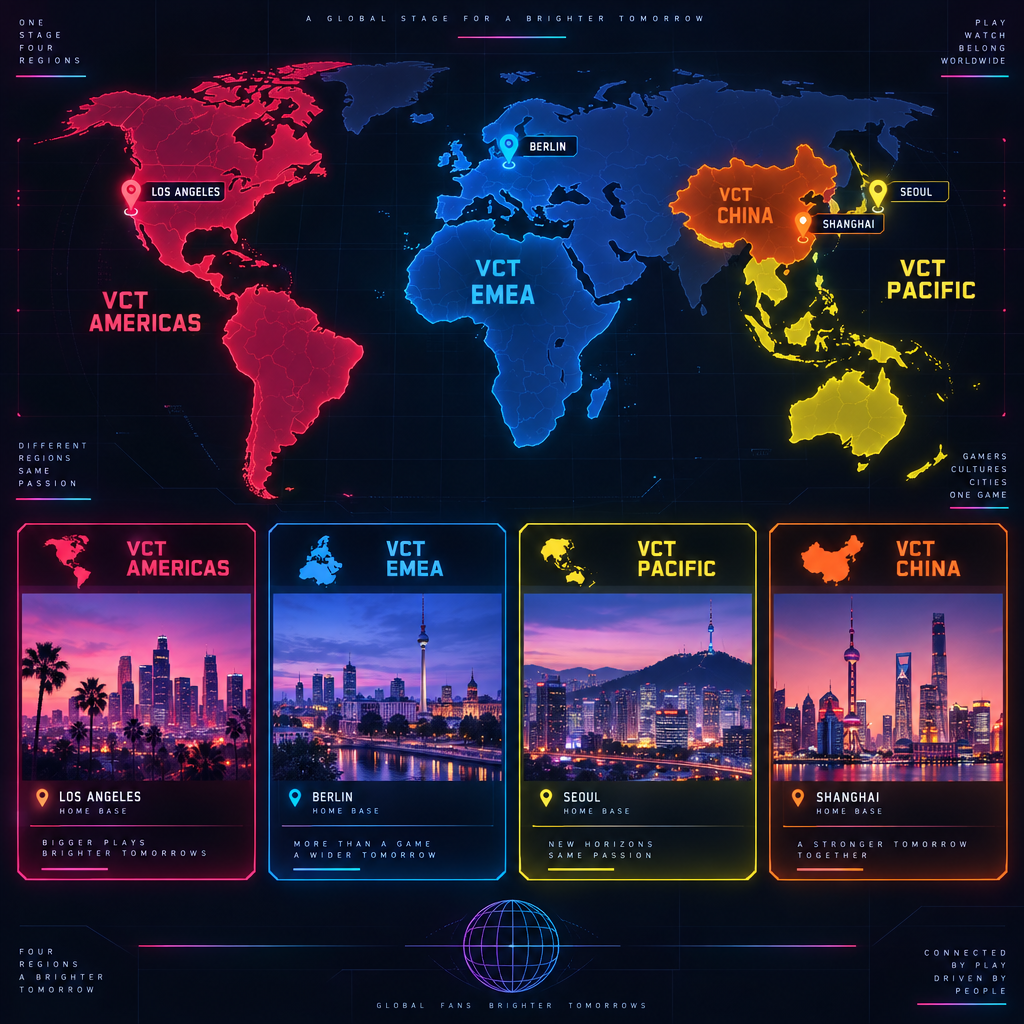
| VCT Americas | North America, Brazil, Latin America | Los Angeles |
| VCT EMEA | Europe, Turkey, CIS, Middle East, Africa | Berlin |
| VCT Pacific | Korea, Japan, Southeast Asia, South Asia, Oceania | Seoul |
| VCT China | Mainland China | Shanghai |
Each league has partnered teams with multi-year contracts, plus Ascension teams that won promotion from Challengers. Most leagues have settled at around 12 teams each, though the exact count can change when Riot adjusts the format or a team exits.
The league names matter for viewing. EMEA matches usually land in European afternoons and evenings. Pacific and China matches often run overnight or early morning in the Americas. The Americas broadcast is in North American afternoons, which is late night in Europe. If we are following a team outside our own time zone, we plan around VODs.
How a VCT season flows
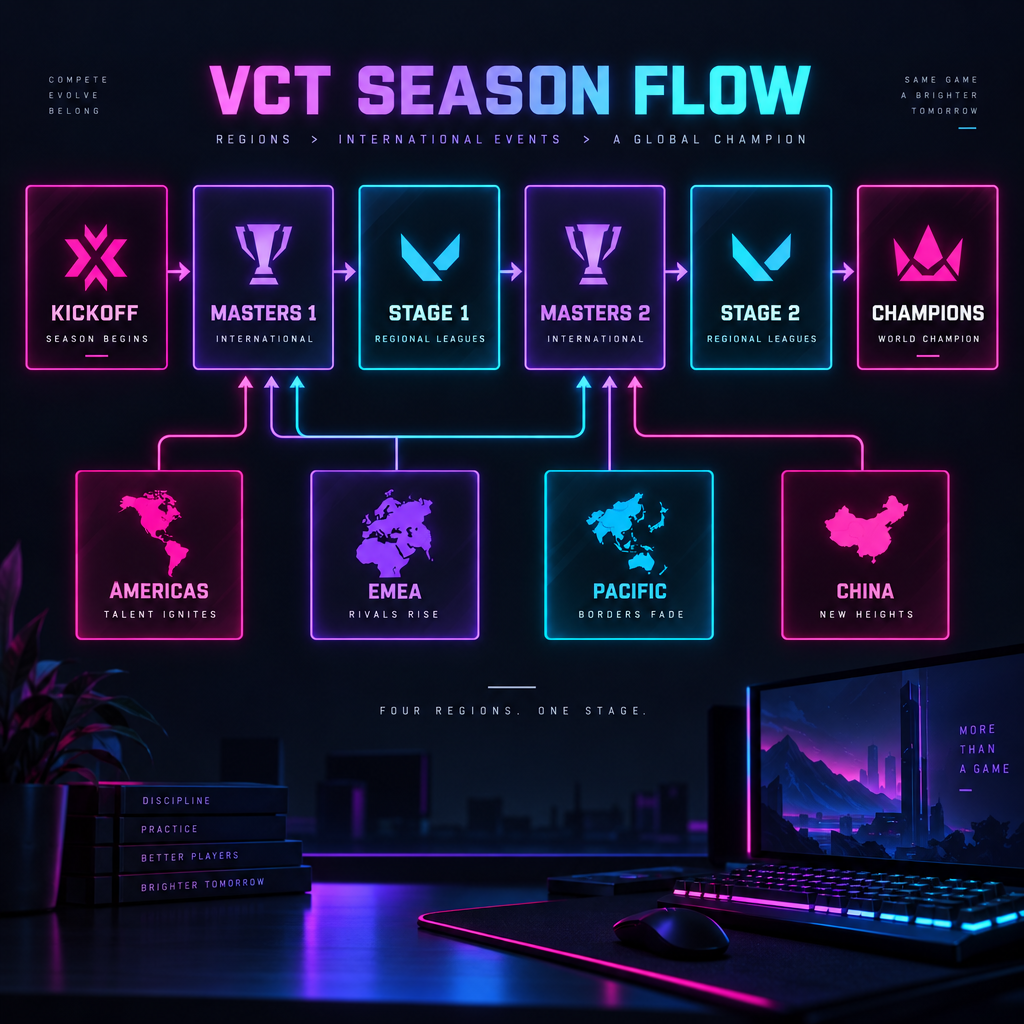
The calendar has the same shape every year. Regional play comes first, an international event follows, and the cycle repeats.
| Phase | What happens | Why it matters |
|---|---|---|
| Kickoff | Short regional tournament to open the year | Top finishers qualify for Masters 1 |
| Masters 1 | First international event | Early read on which region is ahead |
| Stage 1 | Regional league play with groups and playoffs | Top teams qualify for Masters 2 |
| Masters 2 | Second international event | Championship Points and seeding |
| Stage 2 | Final regional stage | Last chance to qualify for Champions |
| Champions | Season-ending world championship | Crowns the world champion |
Kickoff
Kickoff opens the year in January and February. In 2025, each league ran Kickoff as a triple-elimination bracket. That format is forgiving, because a team has to lose three series before it is out. Teams still adjusting to roster changes get room to recover from a bad first series.
Kickoff is the first real test of offseason rosters. We pay attention to which new five-man lineups actually click and which ones only looked good on paper.
Masters
Masters is the mid-tier international event, and there are two per season. In 2025, Masters Bangkok had 8 teams (the top two from each Kickoff), and Masters Toronto expanded to 12 teams. Masters titles carry real prestige. Sentinels won Masters Madrid in 2024 and Gen.G took Masters Shanghai that same year. T1 won Bangkok in 2025, and Paper Rex won Toronto.
Champions and Championship Points
Champions is the event every team builds toward. Since 2024, Riot has used Championship Points earned across the season, including Kickoff, Stage placements and Masters runs, to decide part of each league’s Champions qualification. The rest of the spots come from Stage 2 playoff results. In 2025, each league sent four teams, for 16 at Champions.
In practice, a team that had a great spring can effectively bank its Champions spot before Stage 2 begins. A team that stumbled early needs a deep Stage 2 playoff run to get in. Watching the points standings in the summer tells us more than the win-loss table does.
Analyst note
Points reward consistency over peaks. A team finishing third in both Stage 1 and Stage 2 can outscore one that wins a single stage and flops in the other. Track the cumulative standings, not just trophies.
VCT 2026: Santiago, London and Shanghai
Riot announced the 2026 international hosts at the end of the 2025 season. Masters 1 goes to Santiago, Chile, which is the first top-tier international Valorant event in South America outside Brazil. Masters 2 is in London. Champions 2026 is in Shanghai, which brings the world championship to China for the first time.
The Shanghai choice reflects how far VCT China has come. EDward Gaming won Champions 2024 in Seoul. That was the first world title for a Chinese team, and it changed how the other regions view the China league. Hosting Champions there is a direct result of that.
We are deliberately not quoting exact match dates here. Riot sometimes shifts days, venues and formats after the initial announcement. The official VCT schedule page and the Valorant Esports accounts are the sources we treat as final. Use the general pattern as a guide: Kickoff in winter, Masters 1 in late winter or early spring, Masters 2 in early summer, and Champions in late summer or early autumn.
Partnered teams, Ascension and Challengers
The structure below the four leagues is easy to overlook. It is also what separates VCT from a closed franchise model.
Partnered teams signed long-term agreements with Riot in 2022. They receive a stipend and a share of revenue from in-game VCT items, and in exchange they cannot be relegated.
Challengers is the tier-two layer. Riot and its partners run regional Challengers circuits around the world, open to anyone who can qualify. Tier-two organizations, academy rosters and teams of players hoping to break into the big leagues compete here.
Ascension connects the two. The winners of each region’s Ascension tournament earn a spot in their international league for two years. If they perform well enough, they have a path to staying longer. Several Ascension teams have made deep runs in their leagues, which keeps pressure on partnered teams that coast.
Many casual viewers only watch the international leagues. That means missing the players who will be in them next year, because a lot of current VCT stars came up through Challengers.
Game Changers
VCT Game Changers is Riot’s circuit for women and marginalized genders. It has its own regional events and a Game Changers Championship each year. It runs alongside the main tour rather than inside it, but players from the Game Changers scene have also competed in Challengers. Teams such as Shopify Rebellion and Team Liquid Brazil have been regular names at the top of it.
Recent VCT results
These are the results we would cite when someone asks who has won what. They are useful for understanding regional strength over time.
| Year | Champions host | Champions winner | Masters winners |
|---|---|---|---|
| 2021 | Berlin | Acend | Nu Fnatic… see note* |
| 2022 | Istanbul | LOUD | OpTic Gaming (Reykjavík), FunPlus Phoenix (Copenhagen) |
| 2023 | Los Angeles | Evil Geniuses | Fnatic (Tokyo) |
| 2024 | Seoul | EDward Gaming | Sentinels (Madrid), Gen.G (Shanghai) |
| 2025 | Paris | NRG | T1 (Bangkok), Paper Rex (Toronto) |
*2021 Masters events ran under an older format. Sentinels won Masters Reykjavík and Gambit Esports won Masters Berlin.
At Champions 2025 in Paris, NRG beat Fnatic in a five-map grand final. That result came after NRG’s roster rebuilt around veteran leadership, and it was a big moment for VCT Americas after two years where Pacific and China teams had taken most of the attention. Fnatic reaching another final kept them as the most consistent European organization of the franchised era.
The table points to a broader conclusion: no region has dominated. Champions has gone to EMEA, Brazil, North America, China and North America again. That spread is one reason Valorant esports stays watchable. Picking a winner before the season starts is genuinely hard.
How to follow VCT without missing matches
Quick steps: follow a VCT season
- Pick one or two leagues to follow live.
- Save the official schedule and convert times to your zone.
- Follow the Valorant Esports channels on Twitch and YouTube.
- Pick a co-streamer you enjoy for match-day energy.
- Join a team or watch-party Discord for reminders.
Schedule and standings
The official Valorant Esports site lists the full schedule, results and standings for every league and international event, with times converted to your local zone. It also shows Championship Points standings, which, as covered above, matter more than they look.
Community stat sites track maps, agents and player ratings in more depth. We use them for analysis, but we treat the official site as the source of truth for times and qualification.
Streams, co-streams and the #VCT hashtag
Riot broadcasts every VCT match on its official Twitch and YouTube channels, with separate broadcasts for different languages. Riot also runs a co-streaming program. Approved creators can rebroadcast matches with their own commentary. For big events, this is often where a lot of viewers end up. Co-streams usually trail the official feed by a few seconds and add personality, while the official feed has the cleanest observer work and analyst desk.
Riot has run watch rewards and Twitch drops at various points. When they are active, they require linking your Riot account through official channels, and the details change each year. The #VCT hashtag on social platforms is where clips, roster news and match discussion collect during events.
If we want to co-stream ourselves after being accepted into the program, a solid “streaming setup” and a working “obs studio” scene with a delay buffer both matter. VOD-review content needs a capable “gaming pc” or “gaming laptop” to scrub through demos smoothly.
Following VCT through Discord
This is where Toopics comes in. The most useful Discord servers for VCT fans fall into three types:
- Team servers. Most partnered organizations run official Discords with match-day pings, roster announcements and watch parties.
- Watch-party and co-streamer servers. These are great for live reactions, especially for overnight Pacific or China matches when your local friends are asleep.
- Regional esports hubs. These are useful if you follow Challengers or Game Changers, which get less mainstream coverage.
Server owners can automate match reminders with a notification bot. A “mee6 bot” setup with Twitch and YouTube alerts pointed at the official Valorant Esports channels covers most needs. Create a dedicated “match-day” role so you aren’t pinging the whole server every time.
Stay safe
Event weeks bring fake “free Champions bundle,” fake drops and fake Nitro DMs. Riot never asks for your login through Discord. Ignore any link promising VP or skins for watching.
Reading VCT like an analyst
Following results is easy. Understanding why they happen takes a few habits.
Watch the patch, not just the team. International events are played on a specific game patch, and agent balance changes can flip the meta. A team built around one composition can look unbeatable at a Masters and ordinary a month later. Before an event, check which patch it uses and what changed.
Watch the map pool. VCT uses a seven-map competitive pool that Riot rotates through the year. Veto phases decide a surprising number of series. A team with deep comfort on five maps beats a team with three great maps and four weak ones, especially in best-of-five playoffs.
Watch the in-game leader. Roster changes involving the IGL affect a team far more than changes to a single fragger. That is part of why Kickoff results are unreliable predictors. Teams with new leaders often need a full stage to settle.
Compare regions only at international events. Domestic dominance doesn’t automatically translate. Several teams have topped their league and then gone out early at Masters. Treat the two Masters events as the real cross-regional data points.
Fans coming from League of Legends will notice the parallels. Riot built VCT on lessons from its LoL esports structure, and Champions plays a role similar to “league of legends worlds.” The differences are a shorter history and more open competition between regions.
The rulebook and League Handbook
Riot publishes the VCT Global Competition Policy along with league-specific handbooks. They cover roster rules, player eligibility, technical pause procedures, map veto rules and penalties. Most fans never read them. However, they explain the controversies that pop up every season, such as a forfeited map, a roster lock dispute or a pause that went too long.
Some useful defaults: players need to meet a minimum age requirement to compete in VCT, rosters have registration deadlines before each stage, and teams can face sanctions for policy violations. If a ruling surprises you during an event, the handbook usually explains it in a paragraph.
FAQ
What does VCT stand for?
VCT stands for Valorant Champions Tour. It is Riot Games’ official professional circuit for Valorant, covering regional leagues, Masters events and the Champions world championship.
What is the difference between VCT and Champions?
VCT is the entire season. Champions is the final tournament of that season, where qualified teams from all four leagues compete for the world title.
Where is Valorant Champions 2026?
Riot has announced Shanghai, China as the host city for Champions 2026. The two Masters events before it are in Santiago and London.
How do teams qualify for Champions?
Teams qualify through their regional league. Some spots come from Stage 2 playoff results, and others come from Championship Points earned across Kickoff, Stage 1, Stage 2 and Masters.
Where can I find the VCT schedule?
The official Valorant Esports site lists the full schedule, standings and results in your local time zone. Riot’s Valorant Esports channels on Twitch, YouTube and social media also post daily match times during events.
Can an amateur team reach VCT?
Yes. Teams can qualify through Challengers in their region, then win the Ascension tournament to earn a two-year spot in one of the four international leagues.