
Freeware games are complete games the developer gives away with no purchase, no account requirement and no in-game shop, and the best of them hold up against paid releases. Our list covers 15 downloadable picks from Cave Story to Dwarf Fortress Classic, plus the strongest open source projects, browser-based freeware games online and a safety checklist for getting them running without picking up malware.
What “freeware” means, and what it does not
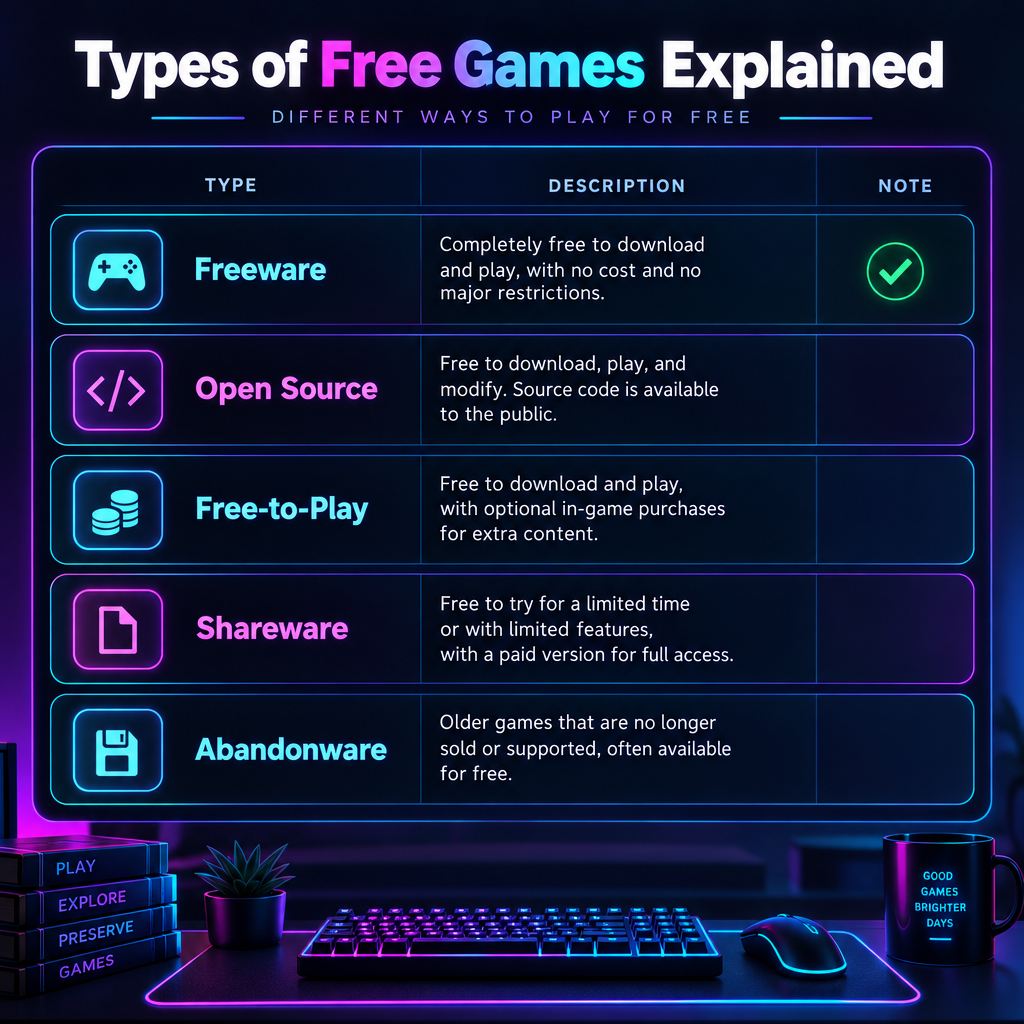
The word gets stretched a lot. Storefronts label anything with a $0 price tag “free”, so a 1993 shareware episode, a free-to-play shooter with a cosmetic shop and a limited-time giveaway all land in the same search results. For this list we use the narrow definition: the full game, free to download and keep, with no paid tier required to see the whole thing.
| Category | What you get | Catch | Examples |
|---|---|---|---|
| Freeware | Complete game, free forever | Sometimes a paid remaster exists alongside it | Cave Story, Yume Nikki, Iji |
| Open source | Complete game plus source code | Some projects need original game assets | OpenTTD, Battle for Wesnoth, Mindustry |
| Free-to-play | Core game free, monetised in-game | Cosmetics, battle passes, item shops | Fortnite, League of Legends, Fall Guys |
| Shareware | First chunk free, rest paid | Only part of the game | Doom (1993), Commander Keen |
| Promotional giveaway | Full paid game, free for a window | Needs a store account, offer expires | Epic Games Store weekly free game |
| Abandonware | Old commercial game, hosted without permission | Copyright still applies, often still sold on GOG | Most “abandonware” sites |
Free-to-play is the big one people confuse with freeware. Fortnite costs nothing to install, but the whole business runs through the daily rotation of the fortnite item shop. League of Legends funds a global esports circuit that peaks at League of Legends Worlds, and the money for that comes from skins. Those games are free to start. Freeware games are free, full stop.
Abandonware is the other trap. Sites that host 1990s commercial titles rely on nobody enforcing copyright, and plenty of those games have since been re-released on GOG or Steam for a few dollars. We don’t treat those as freeware, and we left them off this list. If a publisher has formally released a game for free, as Westwood’s owner EA did with the original Command & Conquer in 2007 and Red Alert in 2008, it counts.
How we picked these 15
Our criteria were simple. The game had to be complete, still legally free from the developer or an official store, and still runnable on a current Windows 11, macOS or Linux machine without an emulator (ScummVM counts as an official distribution method for two of them). We skipped games that need you to supply the assets from a commercial release, with the exception of a note on OpenRA in the open source section.
We also weighted for length and depth. A 20-minute browser toy can be brilliant, and we cover a few later, but the main list is for games that justify a folder on your drive for weeks. Finally, we checked that each one still has a living community, because a freeware game with an active Discord and a wiki is far easier to get into than one where the only help is a dead forum thread from 2009.
The 15 freeware games worth downloading
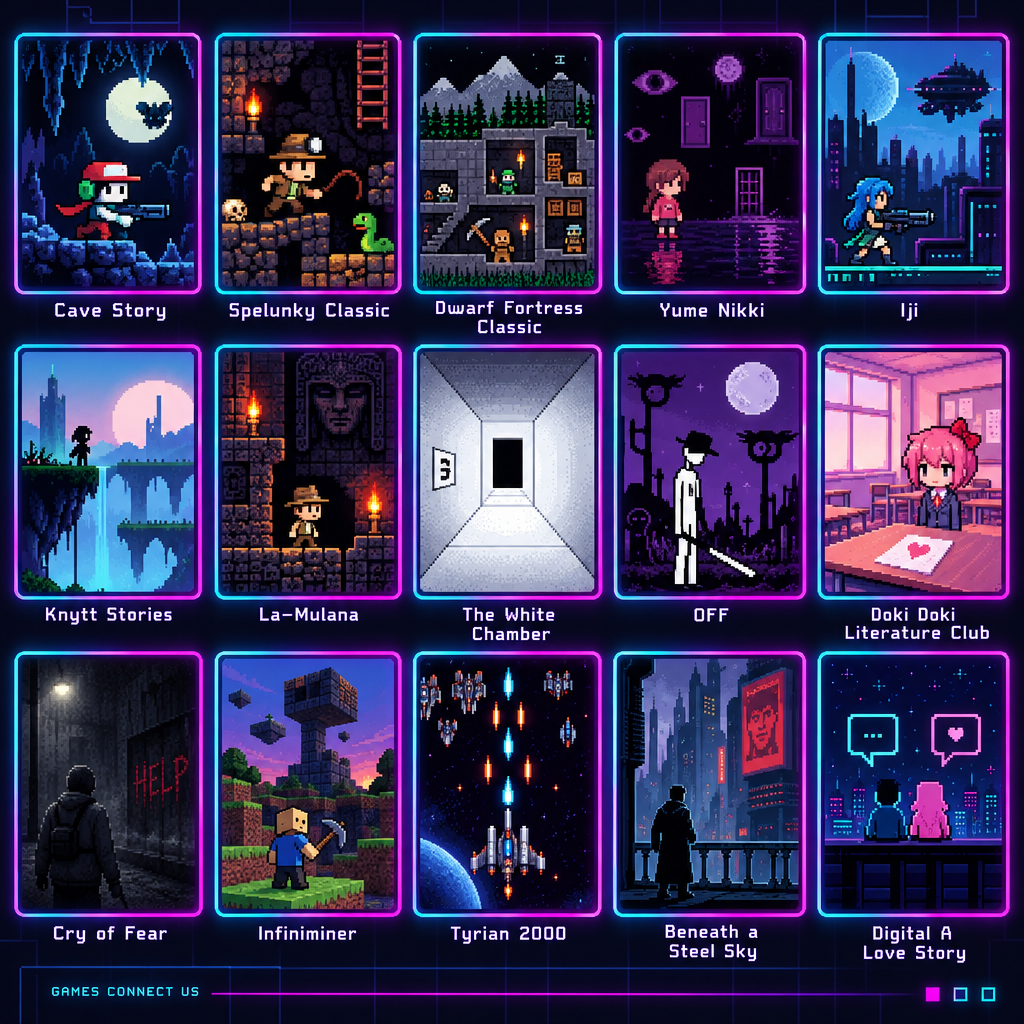
| Game | Released | Genre | Developer | Still free from |
|---|---|---|---|---|
| Cave Story | 2004 | Action platformer, Metroidvania | Studio Pixel (Daisuke Amaya) | Developer site (original version) |
| Spelunky Classic | 2008 | Roguelike platformer | Derek Yu (Mossmouth) | Developer site |
| Dwarf Fortress Classic | 2006 | Colony sim, roguelike | Bay 12 Games | Bay 12 site |
| Yume Nikki | 2004 | Exploration, surreal adventure | Kikiyama | Steam, developer site |
| Iji | 2008 | Action platformer | Daniel Remar | Developer site |
| Knytt Stories | 2007 | Exploration platformer | Nifflas | Developer site |
| La-Mulana (original) | 2005 | Puzzle platformer | GR3 Project | Developer archive |
| The White Chamber | 2005 | Point-and-click horror | Studio Trophis | Developer site |
| OFF | 2008 | Surreal RPG | Mortis Ghost | Fan translation hosts, itch.io |
| Doki Doki Literature Club | 2017 | Visual novel, psychological horror | Team Salvato | Steam, itch.io |
| Cry of Fear | 2012 | Survival horror | Team Psykskallar | Steam |
| Infiniminer | 2009 | Multiplayer mining sandbox | Zachtronics | Developer site |
| Tyrian 2000 | 1995 (free 2004) | Vertical shoot-’em-up | Eclipse Software | OpenTyrian project |
| Beneath a Steel Sky | 1994 (free 2003) | Point-and-click adventure | Revolution Software | ScummVM, GOG |
| Digital: A Love Story | 2010 | Interactive fiction | Christine Love | itch.io, developer site |
Cave Story (Doukutsu Monogatari)
Daisuke “Pixel” Amaya spent about five years building Cave Story alone and released it for free on 20 December 2004. It remains the benchmark for what one person can ship as freeware. The game plays like a cross between Metroid and a 16-bit action platformer: ten weapons that level up through collected experience crystals, a cast of rabbit-like Mimigas, and a map that opens up as you find the Booster jetpack and the Machine Gun.
The structure rewards replaying. There are three endings, and the best one is gated behind choices you can lock yourself out of hours earlier, including refusing an early weapon trade to keep the Polar Star for its Spur upgrade and which version of the Booster you end up carrying. Reaching the final hidden area, the Blood-Stained Sanctuary, is one of the hardest sequences in any freeware game, and speedrunners still compete on it.
Nicalis sells Cave Story+ on Steam and Switch with redrawn art and extra modes, but the original Japanese freeware build on Pixel’s site, paired with the long-standing English fan translation, is the version most of the community still recommends for a first playthrough. It runs on Windows 11 without tweaks.
Spelunky Classic
Before the 2012 remake and 2020’s Spelunky 2, Derek Yu released the original Spelunky as a free Game Maker project in late 2008, and later published the source. This is the game that popularised the roguelike platformer: four randomly generated worlds (Mines, Jungle, Ice Caves, Temple), permadeath, and a physics-driven set of systems where a thrown rock, a shopkeeper’s shotgun and an arrow trap can chain into disaster in two seconds.
Classic is slower and smaller than the paid remake, with 16 levels per run instead of the HD version’s larger, more detailed stages. That makes it a better teaching tool. You can see each system in isolation, and a full winning run takes around 20 to 30 minutes once you know the routes. The damsel, the ghost that appears if you dawdle past the timer, and the City of Gold secret are all present.
The source release led to community forks that add widescreen support and bug fixes, and those are worth grabbing from the developer’s page or the well-known fan projects rather than random mirrors.
Dwarf Fortress Classic
Tarn and Zach Adams first released Dwarf Fortress on 8 August 2006 and kept it free, funded by donations, for 16 years. On 6 December 2022 a Premium version with pixel art tiles, mouse support and music launched on Steam and itch.io for $29.99 and, by the developers’ own reporting, comfortably passed half a million sales within weeks. The Classic version did not go away. It is still free on the Bay 12 Games site and still receives the same simulation updates.
Analyst note
Premium and Classic share the same world generator and simulation code. The $29.99 buys you the tileset, mouse-driven UI and soundtrack; the free Classic build is ASCII with keyboard menus. If you are willing to learn the keys, you lose nothing in depth.
What you get is the deepest colony simulation ever shipped: procedurally generated worlds with hundreds of years of recorded history, dwarves with individual memories and preferences, fluid dynamics for water and magma, and an Adventure Mode where you walk that same world as a single character. The learning curve is real. Plan on a wiki tab open and a few lost fortresses before anything survives a second winter.
Yume Nikki
Kikiyama’s Yume Nikki (the title translates roughly as “dream diary”) first appeared in 2004, built in RPG Maker 2003 and updated through version 0.10 in 2007. In 2018 it was republished free on Steam, which is the easiest place to get it now. You play Madotsuki, a girl who refuses to leave her apartment, and the entire game takes place in her dreams.
There is no combat, no dialogue and almost no guidance. The goal is to collect 24 “effects” scattered across a dozen interconnected dream worlds, each of which changes Madotsuki’s appearance or abilities. Finding them means wandering maps that loop on themselves, following the logic of nightmares rather than level design. It is slow, oddly peaceful and occasionally genuinely frightening.
Its influence is bigger than its size. The whole “RPG Maker horror” scene, from Ib to OMORI, traces back here. A paid 3D reimagining, Yume Nikki: Dream Diary, released in 2018, but the original is the one that matters.
Iji
Daniel Remar released Iji in 2008 after four years of solo work, and it is still one of the best freeware action games on Windows. Iji wakes up in a military complex months after an alien invasion, with nanotech implants that let her upgrade health, attack, defense, crack (hacking), and alien weapon skills. Ten sectors of side-scrolling action follow, with a kill count that the game tracks and the story reacts to.
That reactive design is the hook. Play as a pacifist and enemy soldiers talk about you differently, bosses behave differently and the ending changes. Play as a killer and the game acknowledges that too. Remar also built in a hidden hard mode, secret weapons that combine two guns into one, and a full set of difficulty options. The soundtrack by Chris Geehan and Dan Byrne-McCullough still holds up.
Remar’s later freeware game Hero Core (2010), a monochrome Metroidvania shooter, belongs on the same download list.
Knytt Stories
Nifflas (Nicklas Nygren) followed his 2006 exploration game Knytt with Knytt Stories in 2007, and it ships with a built-in level editor that turned it into a platform rather than a single game. The included campaign, “A Strange Dream”, is about an hour long. The community-made levels number in the thousands, ranging from ten-minute vignettes to multi-hour adventures that rival commercial releases.
The game itself is minimal: Juni can run, climb walls, double jump and later use an umbrella and a hologram decoy, with each power-up found in the world. There are no hit points. Touch an enemy and you restart from the last save point, which keeps the pace brisk. The art is tiny pixel sprites over hand-drawn backgrounds, and the ambient soundtrack does more work than most full orchestral scores.
If you want a gentler introduction to exploration platformers than Cave Story, start here and then dig into the community level archives.
La-Mulana (original version)
Nigoro’s 2012 La-Mulana remake is a paid game, and a very good one. The 2005 original from GR3 Project is free, and it is a different experience: deliberately styled after MSX computer games, with chunky sprites and the same brutal puzzle design. Archaeologist Lemeza Kosugi explores ruins packed with traps, hidden switches and riddles written on stone tablets, most of which require actual note-taking.
This is a game that will kill you for stepping on the wrong tile and will hide progress behind a wall you have to deliberately weight-trigger with a dropped item. It has roughly 20 interconnected areas and a run to the true ending takes most players 30 to 40 hours. The MSX framing is more than a visual choice; software cartridges you collect in-game grant abilities and combine in ways the game never explains.
An English patch has existed since 2006. The original is harder to track down than most entries here, so stick to the developer’s archive or the well-documented community mirror rather than a search result download site.
The White Chamber
Studio Trophis released The White Chamber in 2005, and it remains one of the strongest freeware point-and-click adventures. You wake in a coffin-shaped chamber on an abandoned space station with no memory, and the rest of the game is a slow uncovering of what happened to the crew. The hand-drawn, anime-influenced art looks like a lost 1990s OVA, and the station is small enough that you learn its layout quickly and large enough to hide secrets.
Its reputation rests on the horror. Rooms shift, the station’s lone human remains move when you aren’t looking, and the puzzles escalate from inventory logic into something closer to a psychological test. There are multiple endings, decided by how you behave toward what you find rather than by a single late choice, which gives it real replay value for a game that runs about three to four hours.
It uses the Wintermute engine, so it needs no compatibility tricks on modern Windows.
OFF
Mortis Ghost’s OFF was released in French in 2008 and reached English in 2011 through a fan translation, which the developer endorsed. Built in RPG Maker 2003, it stars the Batter, a purifier sent through four zones to wipe out spectres, with you, the player, addressed directly as the one controlling him. The turn-based combat is competent but secondary. The world is the point: stark white and red landscapes, workers who speak in flat corporate phrasing, and a steadily growing sense that the mission is not what it seems.
OFF is roughly six hours long and is the single most-recommended “weird RPG Maker game” for good reason. The fan translation and the original are both free. Avoid spoilers; the second half depends on them.
Doki Doki Literature Club
Team Salvato’s 2017 visual novel is free on Steam and itch.io, and the paid Doki Doki Literature Club Plus (2021) adds side stories and higher-resolution art without changing the core game. The base release is the complete experience: about four hours, four characters, a high school literature club and a poem-writing minigame. The game carries a content warning for a reason, and we will leave it at that.
What makes it worth listing beside 20-year-old classics is how well it uses the Ren’Py engine and the Windows file system as part of the story. Players who have never touched a visual novel can finish it, and the way it manipulates its own save data and character files is still the best-known example of a game stepping outside its window.
Cry of Fear
Cry of Fear started as a Half-Life mod from Swedish team Psykskallar and released in February 2012; a standalone free version arrived on Steam in April 2013, which is where you should get it. It is survival horror in the Silent Hill mould, set in a fictional Swedish city at night, with a limited inventory of six slots, a camera phone used as a flashlight, and enemies that reward careful melee timing.
The campaign runs 8 to 10 hours and has five endings. There is also a four-player co-op campaign with its own map set and custom campaign support, which the community used for years afterward. The GoldSrc engine shows its age in the animations, but the sound design and level layouts are still unsettling. A free game with this much content in 2013 was an anomaly, and it still is.
Infiniminer
Zach Barth’s Infiniminer, released by Zachtronics in April 2009, was built as a competitive team mining game: two teams of players dig through a voxel map, haul ore back to the surface and build structures from blocks. It lasted a month before being decompiled by cheaters, at which point Barth released the source and moved on. The game it inspired was Minecraft. Markus Persson has been open about that lineage, down to the block-based world and the mining-then-building loop.
It is short on content by modern standards, with a handful of map types and simple block physics, but the core loop is sound and it runs in minutes on any modern PC. Treat it as a piece of history that is still fun with a server full of friends.
Tyrian 2000
Epic MegaGames published Tyrian in 1995 as a vertical shoot-’em-up with a shop system, a branching campaign and a surprising amount of story told between stages. Programmer Jason Emery, artist Daniel Cook and composer Alexander Brandon (later of Deus Ex) made the team. In 2004 the assets were released as freeware, and the OpenTyrian project reimplemented the engine so it runs natively on Windows, Mac, Linux and more.
The weapon system is the draw. You juggle front and rear guns, sidekicks, shields and generators across five episodes, with money earned from kills and secret levels. There are over 50 levels across the campaign, a two-player co-op mode and an arcade mode, all of it polished to a degree that freeware rarely reaches. OpenTyrian is the correct way to play it today; the original needs DOSBox.
Beneath a Steel Sky
Revolution Software’s 1994 cyberpunk adventure, with art by Watchmen co-creator Dave Gibbons, was released as freeware in 2003 through the ScummVM team. It is also free on GOG. Robert Foster is dragged from the Australian outback to Union City, a layered dystopia where the rich live at ground level and the poor live in the towers, and the plot escalates into AI, corporate conspiracy and a genuinely good twist.
It is about eight hours long, with the usual pre-Monkey Island 2 adventure logic softened by a clear interface and the robot sidekick Joey, who can be moved between different shells for different abilities. Revolution’s 2020 sequel Beyond a Steel Sky is paid, but the original is better written. Run it through ScummVM, which handles the resolution and speed on modern displays.
Digital: A Love Story
Christine Love’s 2010 interactive fiction piece is set “five minutes into the future of 1988”, played entirely through a simulated Amiga-style desktop and a dial-up BBS. You read messages, reply by clicking, and over about two hours uncover a story about artificial intelligence and the early internet. You never type a word of your own dialogue; the game reconstructs your side from the replies you choose, which is a trick that still works.
It is free on itch.io and Love’s own site, runs in Ren’Py, and leads naturally into her later commercial games (Analogue: A Hate Story, Get in the Car, Loser!). For anyone who has never played interactive fiction, this is the lowest-friction way in.
Open source games that play like full releases
Open source overlaps with freeware but is not the same thing: the code is published under a license, which means ports, forks and decades of maintenance. A few of these need no original assets and stand as complete games.
| Game | Genre | First release | License | Needs original assets? |
|---|---|---|---|---|
| OpenTTD | Transport business sim | 2004 | GPL v2 | No (ships OpenGFX, OpenSFX, OpenMSX) |
| The Battle for Wesnoth | Turn-based fantasy strategy | 2003 (1.0 in 2005) | GPL v2 | No |
| Mindustry | Tower defense, factory builder | 2017 | GPL v3 | No |
| Shattered Pixel Dungeon | Roguelike | 2014 | GPL v3 | No |
| Endless Sky | Space trading and combat | 2015 | GPL v3 | No |
| OpenRA | Real-time strategy | 2007 | GPL v3 | Uses freely released C&C and Red Alert assets |
| Stunt Rally | Rally racing | 2010 | GPL v3 | No |
| Micropolis | City builder (SimCity source) | 2008 | GPL v3 | No |
| Cataclysm: Dark Days Ahead | Survival roguelike | 2013 | CC BY-SA 3.0 | No |
| 0 A.D. | Historical RTS | 2010 (alpha) | GPL v2 / CC BY-SA | No |
OpenTTD is the standout. It began as a reverse-engineered Transport Tycoon Deluxe and now ships on Steam for free with its own replacement graphics, sound and music, so no original disc is required. Multiplayer servers run for weeks with dozens of players building rail networks across huge maps. The Battle for Wesnoth is the other deep one: more than a dozen single-player campaigns, a hex-based system with day/night cycles that change unit strength, and an active multiplayer scene.
Mindustry is free on itch.io and GitHub while charging on Steam, which is the developer’s stated way of letting people pay if they want to. Shattered Pixel Dungeon does the same, free on mobile and desktop with a paid Steam listing. Both are complete.
Stunt Rally deserves a mention for racing fans: it is a rally game with a track editor, dozens of circuits and physics borrowed from the VDrift project, which makes it the rare free racing game with real car handling. Micropolis is the actual SimCity code, released under the GPL by EA in 2008 for the One Laptop per Child project and renamed to avoid the trademark. The city simulation is the 1989 original, so expect limits, but the model under the hood is the one that started the genre.
OpenRA is the exception in the table. It needs the game data for Command & Conquer and Red Alert, which EA released as freeware in 2007 and 2008, and the OpenRA installer fetches them. In February 2025 EA went further and open-sourced the original Tiberian Dawn and Red Alert code under the GPL, which has already fed into the OpenRA and related projects.
Freeware games online: browser picks that need no install
Some of the best freeware games online run in a tab. These are the ones we keep coming back to.
| Game | Type | Released | Where | Time to a session |
|---|---|---|---|---|
| Lichess | Chess | 2010 | Browser, mobile apps | Under a minute |
| Cookie Clicker | Idle, incremental | 2013 | Browser (paid version on Steam) | Instant |
| A Dark Room | Text-based survival | 2013 | Browser | 2 to 4 hours total |
| Universal Paperclips | Incremental | 2017 | Browser | 4 to 6 hours total |
| Line Rider | Physics sandbox | 2006 | Browser | Instant |
| QWOP | Physics ragdoll runner | 2008 | Browser | Instant, endless frustration |
| Powder Game | Particle sandbox | 2007 | Browser | Instant |
| Frog Fractions | Genre-shifting comedy | 2012 | Steam (Game of the Decade Edition, free) | About an hour |
Lichess is the serious one. It is a non-profit, ad-free, open source chess server with rated play, puzzles, opening explorers and engine analysis, and it has become the default for many titled players who stream. Nothing is paywalled.
Cookie Clicker, A Dark Room and Universal Paperclips are the three idle games that defined the genre’s narrative potential. Universal Paperclips, designed by Frank Lantz, turns an AI maximising paperclip output into a story about the end of the world in a few hours of clicking. A Dark Room starts with a single line, “the room is cold”, and builds out into a village sim and then something else entirely.
Frog Fractions moved from Flash to a free Steam release in 2020, which keeps it playable now that browsers have dropped Flash. For everything else from the Flash era, two projects matter: Ruffle, a Flash emulator that many sites now embed so old games play in-browser again, and Flashpoint Archive, a preservation project that packages well over 100,000 browser games for offline play. If you want to see what the next generation of browser games looks like, the community-made scratch games on MIT’s Scratch platform are where a lot of young developers start, and the best of them are surprisingly polished.
Where to download freeware games safely
The biggest risk with freeware is not the game. It is the download site wrapping an old executable in a “download manager” that installs toolbars, or a search result pointing at a repack with something extra inside. Our rule: get the file from the developer, from itch.io, from Steam, from GitHub releases or from a long-established community project with a public track record.
Quick steps: download a freeware game safely
- Find the developer’s own site or itch.io page first.
- Check the game on MobyGames to confirm the developer and release details match.
- Download the file directly; skip any “download manager” or installer wrapper.
- Scan the archive with your antivirus or VirusTotal before extracting.
- Extract to a plain folder, not Program Files, and keep the original archive.
Stay safe
Fake download portals often rank above the developer’s site and bundle adware into a wrapper .exe. Freeware games are typically a plain .zip; if a site hands you an installer named “setup_downloader.exe” or asks for your email or a survey, close the tab.
MobyGames is useful here as a reference, not a download source. It lists developer, publisher, release dates and platforms for most of the games above, so if a site claims “official freeware release 2006” you can check that against the record. Internet Archive hosts legitimate copies of some developer-abandoned freeware, but mixes them with abandonware uploads, so verify the status of anything you grab there.
One quirk to know: games built in older versions of Game Maker, which includes Spelunky Classic, Iji and Hero Core, trigger false positives in some antivirus engines because of how the runner packs the executable. A detection on a file downloaded straight from the developer’s site, with a handful of flags on VirusTotal and the rest clean, is almost always a false positive. The same file from a random mirror with 20 flags is not.
Getting old freeware running on Windows 11
Most of this list runs out of the box. The exceptions are games from 2004 to 2010 that use DirectDraw or old DirectX 8 and 9 features, which Windows 10 and 11 handle inconsistently.
Quick steps: fix an old freeware game that won't launch
- Right-click the .exe, open Properties, then the Compatibility tab.
- Tick “Run this program in compatibility mode for” and pick Windows XP (Service Pack 3).
- Tick “Disable fullscreen optimizations” and, under “Change high DPI settings”, enable the override set to Application.
- Install the legacy DirectX End-User Runtime (June 2010) from Microsoft for missing d3dx9 files.
- If graphics are still broken, drop the dgVoodoo2 DirectX wrapper DLLs into the game folder.
| Symptom | Likely cause | Fix |
|---|---|---|
| Game launches to a black screen or 1 to 2 fps | DirectDraw emulation on modern GPUs | dgVoodoo2 in the game folder, or run windowed |
| “d3dx9_43.dll is missing” | Old DirectX 9 runtime not installed | Microsoft DirectX End-User Runtime (June 2010) |
| Multiplayer option greyed out (Infiniminer, old LAN games) | DirectPlay disabled | Settings > Apps > Optional features > More Windows features > Legacy Components > DirectPlay |
| Fullscreen stretched or wrong aspect | High DPI scaling | Compatibility tab > Change high DPI settings > override, Application |
| Audio stutters or no music | MIDI or old sound libraries | Use the engine reimplementation (OpenTyrian, ScummVM) |
| SmartScreen blocks the .exe | Unsigned executable | “More info” > “Run anyway”, only if the download source checks out |
| RPG Maker 2003 game shows “RPG_RT.exe” font or RTP errors | Missing runtime package | Install the RPG Maker 2003 RTP, or use the EasyRPG Player |
Two of the games above are better served by engine reimplementations than by compatibility hacks. OpenTyrian replaces the DOS Tyrian executable entirely, and ScummVM is the official way to play Beneath a Steel Sky. For RPG Maker 2003 titles such as Yume Nikki and OFF, EasyRPG Player is an open source runtime that loads the game data directly and runs on Windows, Mac, Linux and Android; the Steam version of Yume Nikki already bundles what it needs.
Finding people to play with
Freeware communities tend to live on Discord now, and that is where the useful material has moved: fixed builds, widescreen patches, Knytt Stories level recommendations, Spelunky Classic route guides. Developer pages on itch.io usually link the official server, and the game’s Steam community hub will often point there too.
If you join one, check the rules channel first. Established servers for games like Dwarf Fortress run moderation bots that lock new accounts out of file-sharing channels for a day or two, which is sensible given how much of the hobby involves passing .zip files around. For people running a server of their own around one of these games, a few discord bots for gaming handle the basics, such as role assignment for platform (Windows, Mac, Linux) and automatic pinning of the current patched build, which saves answering the same compatibility question daily.
A word on age limits and files: Discord requires users to be 13 or older, some of the games here (Cry of Fear, Doki Doki Literature Club, The White Chamber) carry mature content warnings, and any server that lets strangers post executables needs a scan-before-you-run rule. Treat a file from a Discord DM exactly like a file from an unknown website.
Honourable mentions
A few games we cut for space but would not argue against:
- Hero Core (Daniel Remar, 2010): monochrome Metroidvania shooter, about three hours, with a hard mode that rearranges the map.
- Elona (Noa, 2006): a sprawling Japanese roguelike with an open world, pets, farming and a famously chaotic community. Hundreds of hours if it clicks.
- Within a Deep Forest (Nifflas, 2006): a platformer where you are a bouncing ball; the precursor to Knytt.
- Barkley, Shut Up and Jam: Gaiden (Tales of Game’s, 2008): a post-apocalyptic basketball RPG that is funnier than that description suggests.
- Eversion (Zaratustra Productions, 2008): a short, cheerful platformer that stops being cheerful. The original freeware build is still available alongside the paid HD version.
- SCP – Containment Breach (Undertow Games, 2012): open source first-person horror that spawned a decade of SCP games.
- Slender: The Eight Pages (Parsec Productions, 2012): the game that started the Slender wave, still free, still 15 minutes of tension.
- Doom shareware episode (id Software, 1993): technically shareware, but Knee-Deep in the Dead’s nine maps are free and the Freedoom project supplies free data for the GPL-licensed engine.
FAQ
Are freeware games legal to download?
Yes, when the copyright holder has released them free. Every game in our main list is distributed free by its developer or an official store, which separates them from abandonware sites that host old commercial titles without permission. If a game is for sale on GOG or Steam and a site is offering it free, that is piracy, not freeware.
Is a free-to-play game the same as a freeware game?
No. Free-to-play games such as Fortnite or League of Legends are free to install but monetised through cosmetics, battle passes and item shops. Freeware games are complete with nothing to buy. Some freeware titles have a separate paid edition (Cave Story+, Dwarf Fortress Premium, Doki Doki Literature Club Plus), but the free version is the full game.
Why does my antivirus flag an old freeware game?
Games built in older Game Maker versions and some packed executables from the 2000s trigger heuristic detections because of how they bundle their runtime. If the file came directly from the developer’s site or itch.io and only a few engines on VirusTotal flag it, it is almost certainly a false positive. The same file from an unknown mirror with many detections should be deleted.
What are the best freeware games online that run in a browser?
Lichess for chess, Cookie Clicker, A Dark Room and Universal Paperclips for idle games, Line Rider and Powder Game for sandboxes, and QWOP for physics comedy. Older Flash-era browser games are playable again through Ruffle, which many sites embed, or through the Flashpoint Archive preservation project.
Do freeware games work on Mac and Linux?
Many do, through engine reimplementations. OpenTyrian, ScummVM, EasyRPG Player, OpenTTD, Battle for Wesnoth, Mindustry and Dwarf Fortress all have native Mac and Linux builds. Windows-only titles such as Iji, Knytt Stories and Cave Story generally run well under Wine or Proton, and Cave Story has native ports from community decompilation projects.
Is Dwarf Fortress still free?
Yes. The Classic version on the Bay 12 Games site is free and gets the same simulation updates as the $29.99 Premium version sold on Steam and itch.io since December 2022. Premium adds graphics, mouse-driven menus and music; the underlying game is identical.